Friday, November 29, 2013

Why Do Chinese Cross The Road?

When I first went to Korea, I couldn't believe how poorly they drove. It was like they were given cars without being told how to use them properly. But I have written about that on "What the Kimchi?" I did not think that there worse drivers.
Then I went to Vietnam.
I find somewhat the same situation here in China. They just do not drive with any care or attention. I have been in cars where the driver will make a turn or change lanes without signalling or even looking to see if anybody is there. And the result is plain to see. It seems like every time I have been out on the road, I have seen an accident, or its aftermath. Most of them are simple scrapes and fender benders that could be avoided if the drivers hadn't been trying to one-up each other.
I have seen vehicles driving the wrong way, just to avoid making a little detour. Our bus driver has to avoid these idiots at a certain point on our trip to school each and every day.
So I have made it a rule, I am not going to jaywalk. Even crossing in a crosswalk with the light, I have had to avoid drivers making what in Canada would be illegal turns. You have to keep your head on a swivel or risk certain death.
But the average Chinese are braver (or stupider) than I am. They jaywalk at almost every opportunity, and turn their noses up at safety devices like crosswalks and pedestrian overpasses. They will cross wherever and whenever they want to, despite the traffic. Sometimes I think they are even trying to mess up traffic, like when they wait to cross until just after the light has changed against them.
In front of my apartment building, there is a huge traffic circle, which I have to cross on the way to the bus stop. There are pedestrian underpasses that I use all the time, but the average Chinese will avoid. They would rather cross the road just above the underpass, rather than take the few extra steps. I took the following pictures just in the time it took to go around the circle a coupla times.
Here's one of the underpasses:


and a woman crossing RIGHT NEXT TO it:


Here are two men, walking in the street, RIGHT NEXT TO the underpass:

and then crossing in between speeding vehicles:

Here's another coupla mooks walking on the road:

and crossing straight towards the underpass.
I MEAN, IT'S RIGHT THERE! ARE YOU BLIND?!

A woman walking on the road (at least she's facing traffic. Many people don't):


Here's a woman actually using the underpass, the only person I saw doing so that day, though there were some tracks in the snow:


Here's a woman that I followed around the circle:


She walked on the road rather than the sidewalk, with her back to the oncoming traffic:

and she crossed the road while I took the underpass:

I don't know, maybe she thought I was the crazy one.
But how did the population of China get to be so large, with poor judgement like this?

A Chinese Fire Drill

This week we had a fire drill at the school. We were warned what day it was going to be, but I was a little disconcerted with the instructions about how to act during the drill. The supervisor of my department, "Linda," told me to run to the exit. I wasn't sure I would have to do this, and I didn't plan on trampling over the students in order to make my escape.
They do strange things here at the school, things I am sure would not pass muster in the west. Some of the exits from the school are padlocked shut. There are plenty of other exits, but I wonder what would happen if someone absolutely had to use one of those padlocked exits to escape.
Anyway, the siren for the drill sounded last Wednesday morning, and it was LOUD! It was like one of those old air raid sirens, only it was just in the hallway, so it kind of startled me. By the time I put on my hat and picked up my coat, the other teachers and the students were GONE.
I was astounded. In those few seconds, they had done what they were told, and had run right out of the building. By the time I descended from the third floor out to the walkway in front of the building (through an exit unlocked for the drill, and re-locked the next day), they were all in the athletic field.
They left me to burn to death!
Heh.
"Annie," who co-teaches History with me, said that I should have run. And when we had a second drill later that day, she kept urging me to go faster. She even got behind me and started giving me little nudges in the back.
Oh boy.
So that is a genuine Chinese fire drill.

Saturday, November 16, 2013

JFK 50 Years Later

November 22nd next week will mark the fiftieth anniversary of John F. Kennedy's assassination, as you may have seen on television. The National Geographic channel is marking the occasion by airing "Killing Kennedy," which is adapted from a book by Bill O'Reilly.
I haven't read the book, but most reviews said good things about it. And the movie wasn't that bad, either. But it did stick to the "Oswald did it" storyline, which in my mind has been thoroughly discredited. I've written about my visit to Dealey Plaza before, and my reasons for believing in a conspiracy are explained there.
There is a principle known as Occam's Razor, that in general says that the simplest solution is probably the most likely. When people come up with insanely complicated conspiracy theories about who killed JFK, they are dismissed as nuts who just can't accept that a man as great as Kennedy could be killed by a non-entity like Oswald.
But the more I have read about the assassination, the more I believe in a conspiracy. Yahoo news recently ran a story called "Ten Facts You Don't Know About the JFK Assassination." I'm always interested in learning more, so I gave it a read.
The facts are derived from a book by Brad Meltzer, History Decoded:The 10 Greatest Conspiracies of All Time. They are things that not a lot of people know, such as that the window Oswald shot from disappeared and is in the hands of a private collector. The Sixth Floor Museum has a window it says is the one on display. I don't know, maybe they're mistaken.
Another fact given is that plenty of shooter's replicated Oswald's feat of shooting three times in less than six seconds. I don't think anyone ever disputed this. I think even I could (probably) fire the Carcano in six seconds. Whether I could hit the target, or an expert could replicate the wounds that the "magic bullet" is supposed to have inflicted, is another matter.
I have seen some documentaries try to demonstrate this, but I'm still skeptical. Even with computer modelling their conclusions do not shake my conviction that a bullet struck Kennedy in the front of his head, driving him back and to the left. Simple physics proves a conspiracy.
Meltzer's fact about the magic bullet is that rather than being pristine, which he says most people believe, it is flattened on one side. After traversing the bodies of two men, smashing bones and piercing tough skin, it is flattened on one side.
I roll my eyes.
Another fact, that Oliver Stone's film "JFK" damaged history, is probably true. People may have missed Stone's statement that he merely wanted to start a conversation, or that "JFK" is a film made in Hollywood, which is also known as the "Dream Factory." Anyone who relies on Hollywood for their facts probably believes there's a dinosaur park in Central America.
Heh.
The investigation by the Warren Commission was done behind closed doors, and the Kennedy family kept some of the photographs of the autopsy (as well as Kennedy's brain, probably buried privately by Bobby). Things like this led to theories gaining more credence and taking a foothold on the public's imagination. But the Watergate scandal and the revelations that followed also gave people a sense that their government wasn't to be trusted.
There are not a lot of files left in the vaults (the government says) because of recent freedom of information disclosures.
Meltzer pooh-poohs the statement that there were a lot of mysterious deaths after JFK's murder, as if some agency or organization was trying to keep them quiet. He says a lot of these "mysterious" deaths were merely serendipitous accidents or natural causes. An interesting article about some of those deaths can be found here.
Meltzer does say that people should investigate and make up their own minds, which I agree with. Whether or not you believe that Oswald acted alone, you are going to see a lot of films and documentaries, or read a lot of books, this month that may help you make up your mind.

Sunday, November 3, 2013

Eating

I thought that for this post, I would share with you something about the food here. Taking influences from Russia, Mongolia, Korea, and of course, China, Harbin's food is a lot "heartier" than the rest of the country. Stews are very popular, and because the winters are a lot longer, you'll find that cabbage, potatoes, cucumber, and corn are used more here. Chinese BBQ and hot pot are also very popular.
I eat most of my meals at my school. The students board there during the week, and they and the teachers all eat in the dining hall next to the main building.

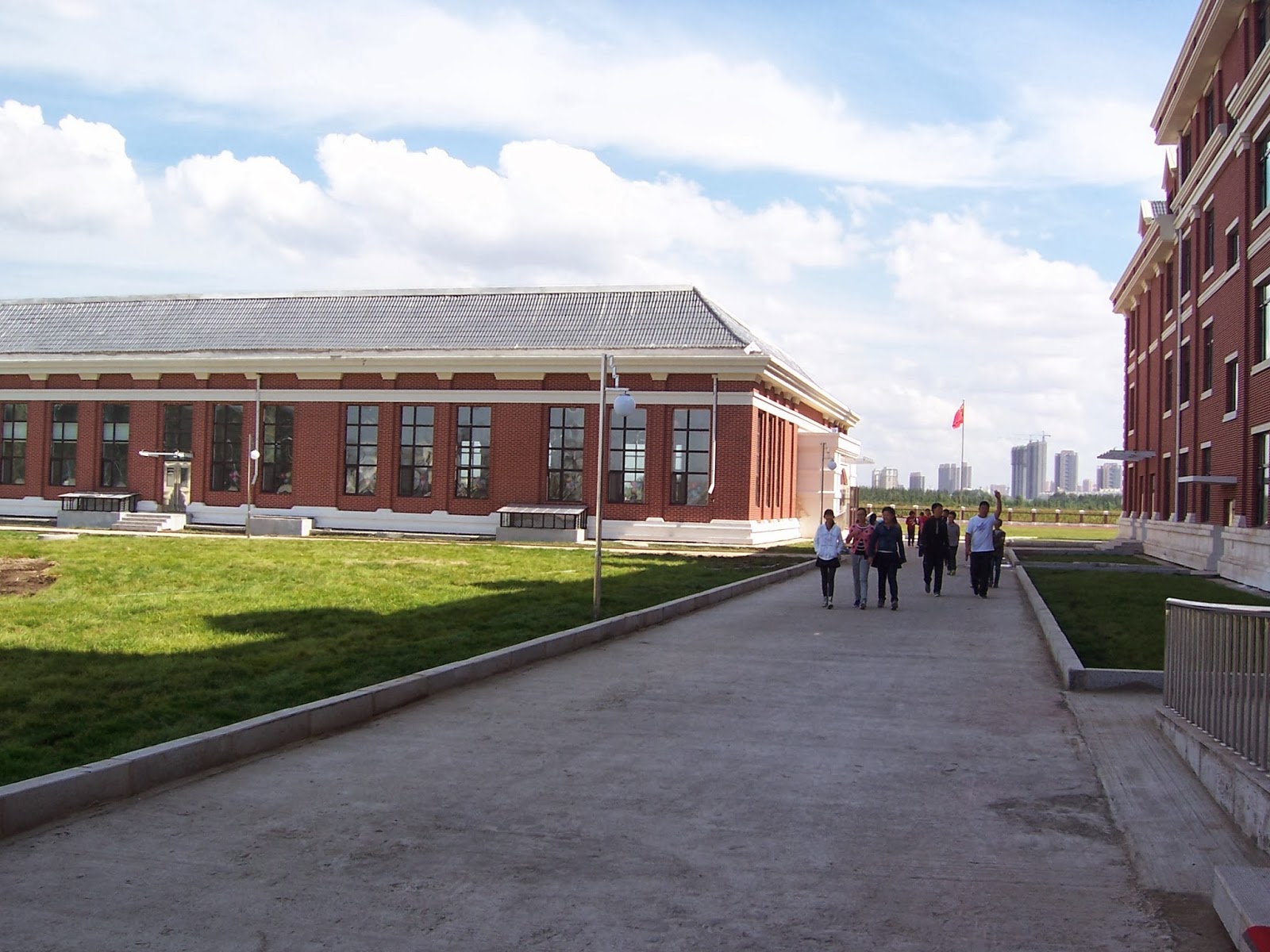
The dining hall (left), opposite the main building


I take the school's bus in the morning, along with other teachers, getting picked up at 7:10 and arriving twenty minutes later. I go straight to the dining hall to have breakfast.


A typical breakfast consists of a hard-boiled egg, a couple of diced vegetable dishes, some watery rice (called congee), and some kind of biscuit. The ones pictured here are my favourite. They're baked to a golden brown. The other teachers go more for the other usual offering, which looks like a cinnamon roll. Except it doesn't have any cinnamon, and it's not baked but steamed. The consistency is kind of like raw dough, so I tend to avoid them.
After breakfast I head up to the third floor where the International classroom is situated, and gather my materials for that day's lessons. I teach History, Geography, and ESL, and I have a fourth class that is an extra helping of one of those three. So I have two classes in the morning, and two in the afternoon.
There are three other teachers in our staff room, plus a supervisor, and we all (except the one who is teaching) head down for lunch about 11:30, just before the student body. 

Lining up to be served lunch

Serving up the food, noodles in this case

Utensils: wooden chopsticks, a spoon, and a wet cloth

Selecting sauce for the noodles

Lunch: a Chinese version of spaghetti and meat sauce

This is an unusual lunch, as we more often than not have a variety of Chinese dishes to choose from. I think they do this lunch for me. The cook asked for a list of food that I like, and this was one of the things on my list. It's pretty good, but I always wish for a fork when I eat noodles. I can use chopsticks fairly well, but I prefer a fork and a knife. 
I like a little salt with my food, too, but my supervisor Linda looks askance when I bring out my salt shaker and keeps telling me it's bad for my health. I tell her that life needs a little extra spice to make it more interesting, but she's still dubious.

The students line up to eat

The dining hall 


Dirty dishes: one big bowl for the soup bowls, another for the utensils, a garbage pail for leftover food, and stack the metal trays at the end

After lunch, I take a half hour walk around the school's athletic running track. If no-one walks with me, I listen to a Chinese language (Mandarin) learning course, and practice the words and phrases. I am getting a little better at it, and what I have learned has turned out to be very useful when I have to communicate when I am shopping or banking or whatever. 
I also have a room where I can go to lie down if I want. Sometimes I listen to my language course a second time, but most of the time I just read. At 1:00, it's time to get ready for afternoon classes.
I head down to the dining hall at 4:30 for dinner. I have to eat early because the bus leaves just before 5.


A typical dinner is three or more of the six or seven dishes there are to choose from, a generous helping of rice, some soup, and a piece of fruit. 
Like I said, there are a lot of stews on the menu, whether it is stewed vegetables or something with meat in it. There is a lot of pork and chicken. Beef is more expensive, so it is a rarity. 
It's not usually very spicy, but sometimes I run into these pieces of a bark-like substance that is like to burn my tongue off if I bite into them. 
The serving of rice you see here is considerably less than most others take. They really pack it away.
The soup is usually a clear broth with some vegetables or an egg stirred into it. And the fruit is usually an apple, an orange, or a banana.
On the weekends, I either eat out or make something for myself at home. It is then that I indulge my craving for western style food. But I haven't eaten at a lot of restaurants as it is still early days. There's a place near my house that makes fresh dim sum that I quite enjoy. You can get a plate of about 20 dumplings for about $2-3 Cdn, and a bottle of beer to go with is about another dollar on top of that. Pretty good.
I have seen western restaurant chains here, too: KFC, McDonald's, and Pizza Hut. Sigh. It's too bad that these represent us to the rest of the world.
I wanted to show you some pictures of the smog that enveloped Harbin a couple of weeks ago. It was a real pea-souper that literally shut down the city.

The dining hall from the main building. The smog was a bit clearer in the middle of the morning, but got worse as the day went on

Looking towards the athletic field

As less than half of the students had shown up that day, classes were cancelled, and we were given the next day off, as well. We had to make up those days we missed on two successive Saturdays. At least we would have, if on Friday the power hadn't gone out. They figured they couldn't get it repaired in time, so yesterday was a day off.
About the middle of last week, I felt an odd shaking as I was sitting at my desk. It was kind of like some sort of construction was causing the building to vibrate, but I later learned that there was an earthquake in Mongolia (just to the west of Harbin), and I had felt the tremor. It was a very odd sensation.
So there have been a few "disasters" here, both natural and man-made. I hope that that's as severe as they get. 
This week coming up is going to be a short one for me, as I am going to Hong Kong on Wednesday to sort out my visa. The one I'm using now is only a temporary one, as this job came up so near to the start of the term they decided to bring me over as soon as possible rather than wait for a regular visa to be approved.
But that's a story for another time.


Saturday, October 5, 2013

I Am Hot

Well, not really.
But I will be once the management company that runs the building decides to turn on the heat. I have heard two dates: the 10th and the 20th of October. Flint will know what I am talking about. In Korea, they did not turn on the heat before a certain date, even if everyone was freezing to death. And in the spring, there is another particular date they wait for to turn on the air conditioning. At least in Korea, the con-apts that I lived in had personal controls so you could heat up or cool down on your own. But not in this worker's paradise. You have to wait just like the rest of the peons.
That's one of the things I will miss about Canada; the thermostat. How did Azrael put it?

No pleasure,
no rapture,
no exquisite sin is greater...
than central air.

On Wednesday last, the owner of this place came in with a workman to replace the radiators.

That's right. I said radiators. Hot water, hissing pipes, the whole bit. I haven't seen radiators since... well jeez, I may be old, but I'm not that old. I don't think I've ever seen a place heated by radiators.
I keep getting warnings from the locals about how bitterly cold the winter is going to be. I'm Canadian, so I just smile quietly to myself. But I guess they think I won't be able to handle it, so the existing rads in my place were replaced with much bigger ones.


The owner and a workman first arrived about 10:30 (I was expecting them at 9:00), looked over what I had, and went away for three hours. When they came back, they spent the afternoon replacing three of the smaller ones with two larger ones, and adding two small ones together.

So I guess I'll be warm enough this winter (once they actually turn the damn hot water on).
By the way, someone asked about the hot water for my shower, if it lasts long enough.
Don't worry, it stays warm plenty. I couldn't say the same about the first shower I had (in Korea), I can tell you. The roommate they stuck me with wasn't too bright, and he couldn't figure out how to make the hot water heater work properly. So he made the school put in a whole new water heater, similar to what I have here in China (only smaller). The problem was, the gas line for it, she came in through the bathroom window (Heh) so that you couldn't close it all the way during the coldest winter in Korean history.
The second roommate I had was much smarter, and he figured out how to fix the water heater so it worked properly.
So to keep on with the upgrades, I've been going to the main part of town as well as exploring my own area, and seeing what there is in the way of shopping. I went downtown to a Carrefour, just to pick up some things to eat. It's a pretty good store. There's not a lot of foreign foods, but I'm used to finding what I need in an Asian supermarket.
Yesterday (Saturday), I went to the big shopping centre, Hongbo Century Square. It is near Harbin's train and bus stations, so there were a lot of big crowds milling around aimlessly. As a manly man among men, I don't like shopping. I like to get in and get out as quickly as possible. But I had to put up with a lot of slow-moving objects in my way. Flint would hate it.
But I did get a good look at what they have there. It's a big underground shopping mall, built somewhat like a maze. I saw some mooks panicking when they couldn't find their way in.
Heh.
 I did see some nice looking clothes that I would like to buy, including some jackets that my sister was talking to me about a while ago. They have these high Manchu-type collars. Very cool.
And I got lost. I got on a bus that I thought was going to take me back to my own neighbourhood, but it went in a whole 'nother direction. I was able to use what Chinese I have learned so far to ask for directions and tell people where I wanted to go, so it all ended happily.
At least I've got that going for me.
Today I went to another shopping centre near my house, just the other side of a university. It's a big one, and it has a lot of stuff that I need. I just may make it my primary shopping place, as it's so convenient.
So it's all coming together.
Now, about that hot water...

Monday, September 30, 2013

Life in Harbin (so far)

October has come in with fog and rain. Typical. I have a week off for China's birthday celebrations, and I'm stuck inside writing this post. Oh well.
On Sunday, our school had a "Sports Day," and all the parents came to see the students (and the teachers) take part in some running events. Even I got roped in to a three-legged type of event. Only it was a seven-legged race, as there were six of us tied together. There were three teams, each with three teachers and three parents. Our team came in dead last. We were co-ordinated enough to reach the finish line without falling over, we were just too damn slow.

The park near my house.

I'm glad of the break, as it will give me some time to get ahead on my lessons. I want to add more than just me talking and pointing to things on the board or the Smartboard, which is what the students are used to, but not quite Canadian style.
I want to start doing a once a week class that will introduce them to some elements of the "Canadian lifestyle," so they won't be quite at sea when they get there. I know more than most how difficult it can be to make the transition to a new country, and I'd like to give them a little heads up.

The city hall for that part of Harbin north of the river.

So let me tell you a little bit about Harbin, which is China's northernmost city, with a population of about 10 million, with over 4 million in the city centre alone. The area where I am in is north of the river, and more sparsely populated. A lot of new development (including my school) being built.
The city was founded in 1897 as a camp for Russian engineers surveying the Trans-Siberian railway (see my earlier posts about my trip). The city takes its name from the original fishing village, which means "a place to dry nets." It kept on growing throughout the 20th Century, enduring occupation by the Japanese during the Second World War, and being fought over during the Chinese communist revolution after that. It is now a major city, a major player in China's economy, as well as the capital of the province of Heilongjiang.

Walking down by the river.

People keep warning me about the cold winter that is coming, but I just come right back with tales of Canadian winters, and tell Harbin's winter to "bring it." I have a fairly warm coat.
So there.
Getting around is pretty easy. Cabs are plentiful and cheap. I took one from the south end of the city to my place for 30 yuan, which is about $5 Cdn. The buses are even cheaper. The one I take to the market costs about 1 yuan (around 16-17 cents. The buses are very similar to the ones I used to take in Korea. Old, uncomfortable, and driven by maniacs who race each other down the street, laying on the horn the whole time.
My first trip to the downtown area took me to the Zhongyang Dajie, or "Central Street," which is blocked off to vehicular traffic. It was Saturday, and the weather was good, so everyone was there. I saw the monument to Flood Control, which commemorates the several times the Songwha River has broken its banks.


A lot of the buildings are in the Russian style, and most of them have been kept up, though they have a variety of different kinds of stores and shops in them now. We found a bookstore where I got a map of the city (all in Chinese), and passed by several beer gardens. There is a beer festival every August, and the local brew is not too bad.
Of course, the big festival occurs in winter, when the main park on Sun Island becomes home to various ice sculptures and houses of ice. I'm looking forward to it.

Tour boat on the river

I am studying Chinese, with a course from Pimsleurs, and I already know a few phrases, enough to get me around somewhat.
There is a Walmart on the central street, and there are various Carrefours, but the selection of foreign foods is limited. There is only one medium sized market in my area, and there are no open air markets at all. The one special treat that we had was an ice-cream bar that is particular to Harbin. There was a steady stream of people going to the various kiosks set up. The ice cream is not bad, kind of a cross between vanilla and white chocolate.
There were a lot of street foods available, from fresh fruit to barbecued meat on a stick. I also saw a lot of stalls that reminded me of the odang stalls back in Korea. Very thick noodles and fried dough. They also do a mean hotpot, and the Russian influence is still seen in the offerings of sausage and bread.
Near the market I go to is a string of restaurants that I have yet to sample. Nearer to my con-apt is a dumpling restaurant (dim sum) which cooks up some really good food.
I've read that there are some Korean restaurants in town, which might be good. I miss Korean food a lot. And when I get desperate, there are a couple of western style buffets at hotels like the Holiday Inn.
All of these things still have to be found and evaluated, the which task I am looking forward to.

Friday, September 20, 2013

Stig Goes to China

It was a long summer of job searching. I must have sent out over a hundred resumes to schools looking for teachers in Alberta, B.C. Saskatchewan, Yukon, and the Northwest Territories. I had one interview, in a school near Edson, but they offered the job to someone else. Friends and former teachers offered me advice, and I tinkered with my resume and fleshed out my online portfolio, but I still received nary an offer.
A friend of mine who I knew from Korea was urging me to apply for a job teaching and China, and so I got in touch with a recruiter that he recommended. I got a job offer from them, but it was retracted after the principal of the school read this blog and "What the Kimchi?". He was upset by the language.


I was beginning to despair when one of my professors passed on information about a job in Harbin, China, teaching Canadian subjects to Grade 10 students who would go on to live and study Grade 11 and 12 in Canada. The recruiter and a representative of the school talked to me via Skype. I think I did most of the talking and asking questions, and I was offered the job fairly soon after the interview. There was some urgency about getting me there, as it was already late August, and classes started the day after Labour Day.


The school, the Harbin American-Canadian Foreign Language School (not sure I like the billing there), was a brand new facility, a branch of an already existing school in Suchow. There were 16 students when I arrived, and two have joined since then. I am thinking that more students will swell the class size as the year progresses.
When I was studying for my degree, and the conversation turned to what kind of school we wanted after graduation, I was always 50/50 on whether I wanted a job in Canada, or a return to overseas work. Since I have made the decision (and especially since I made the trip), I have committed fully to this institution, and intend to do the best job I can.
The need for me to be on the job so quickly necessitated some subterfuge reminiscent of how I used to go to work in Korea. To get a  proper work visa  would take too long, so I came as an exchange teacher, and I will go to Hong Kong at some point soon and get a proper work visa.
The visa process went smoothly, and the recruiter arranged for the ticket. All I had to do was endure the flight from Calgary to Vancouver to Shanghai to Harbin. I wish that I could sleep on airplanes, but nothing I try seems to work, especially when there are a lot of young children and babies making a fuss in the cabin.
I was met at the airport by a couple from the school, and we loaded my bags into the small car for the ride to the school. We all just barely fit inside. The school is set up in the northwest of Harbin, in an area of new developments the other side of the river from the main part of town.


It is quite a river. It is in flood right now, and some islands that are usually parks in the summer are under water. You can see trees and houses sticking up here and there.


The school is quite a facility, and it is so new the builders haven't finished yet. As I was escorted up to a third floor office with the classroom next door, I wondered where everyone was. It seemed like we were the only people in the whole structure. It turns out there are about 100 or so other students in the school. I wondered where they all had been hiding when they all trooped into the dining hall for the afternoon meal.

The teacher's room, with my desk on the far right.

I didn't actually have to teach anything that first day, just meet the students for a couple of minutes. I slept in a hotel that night and moved into an apartment they'd found the next day.
The hotel was interesting. It reminded me of those "Love motels" in Korea, with the various products that complimented the nuts and pop in the mini bar.
There was a product of a company called "Shantone" that promised, "Let you are in intense emotion the safety slips," and "The Man Controls."
Also, "Woman Joy Sex Oil" magic herbs extraction, and his and hers socks and underwear (just in case).
Heh.
The apartment they found for me is pretty nice. It's on the 7th floor, with a view of the river to the east and west - directly in front is another apartment building. I asked if they could knock it down for me, but apparently there's some regulation against it.
Oh well.

My apartment building.

My view to the east...

and the west.

The door of my apartment, with doors to the kitchen (left) and bathroom (right).

The kitchen. I have one, count it: one gas burner.

The bathroom. Note the hot water heater above the tiolet. I have to plug that in and wait 10-15 minutes before the water's hot enough for a shower.
That's the washing machine in the lower left corner.

My wardrobe and bed, with the usual far east style mattress: hard as a rock.

The "living room," with 'puter station, table, and... refrigerator?!

I started in teaching straightaway, and have gradually begun to incorporate more into the lessons than just me talking to them. I have been teaching History, English, and Geography from the Ontario curriculum. There are four other teachers that work with me. They and the students have all taken English names. The supervisor is Linda, and she co-teached English with me when she is not busy with other matters. The other English teacher is Mrs. Zhang. Annie helps me with History class, and my co-teacher in Geography is "Ocean.
The students' English level is not as high as I was expecting, and there have been some struggles as we get used to each other. I have been trying to keep my voice and energy level up, and have had to ask for some interpreting of some of the more difficult language. I have also been trying to make the lessons as relevant and interesting as I can. I teach nineteen 40-minute classes per week. It's been difficult, as there are not as many resources to fall back on like you might find in the average Canadian school. We didn't even have internet for the first week.
But we have been persevering, and I have been working hard to establish a good rapport with the students. The lessons I learned at Ambrose have not gone to waste.I was told on the q.t. (so don't tell anyone, okay?) by Linda last week that the administration of the school has been so happy with my work so far that I may be in line for a bonus. I don't think that the work I have done so far is reflective of the best that I have to offer, but I do think of it as a good start.