Wednesday, August 22, 2012

Inside the Kremlin


World Adventurer (December 5, 2003 Chautauqua)


   In Russia, a "kremlin" is a Russian town's fortified stronghold, and Moscow's was built in the 1150's with a low, wooden wall. It now features high red brick walls 2.25 km long, with Red Square on the eastern side.
 
A map of the Kremlin
 
   The Kremlin's power grew with that of Moscow's princes, and became the headquarters of Russia's churches in the 1320's.

   The "White Stone Kremlin" - which had limestone walls - was built in the 1360's with almost the same boundaries of today. This lasted until 1475-1516, when an era of rebuilding was undertaken by Ivan the Great. Master builders from Pskov and Italy supervised the building of new walls and towers, many of which still stand.

   Even after Peter the Great shifted the capital to St. Petersburg, tsars were still crowned here. Catherine the Great contemplated building a new, classical Kremlin in the 1770's, but she ran out of money.

   Napoleon's troops were making preparations to blow it up, blow it up good, blow it up real good, heh heh heh; but were foiled by rain and the timely arrival of Russian soldiers.

   Hitler had planned to raze the entire city of Moscow from the face of the earth, but it was his fate (and that of his vile regime) to be consigned to oblivion.

   I contemplated my "assault" on the site from one of the most visible monuments to Russia's new capitalism, McDonald's. It sits in a trendy "mall" just across from the western wall, and the Tomb of the Unknown Soldier (Mogila neizvestnogo soldata).  The remains contained inside are that of a soldier who died in December 1941 at Kilometre 41 of Leningradskoe shosse - the nearest the Nazis came to Moscow.
 
Tomb of the Unknown Soldier

   Stretching south from the tomb is the Alexandrovsky Garden, a pleasant little park, with a variety of fountains featuring characters from Grimm's Fairy Tales.
 
 
   The main visitor's entrance is the Kutafya Tower on the Manezhnaya ulitsa. It stands somewhat apart from the main walls, at the end of a long ramp over the park. It is the last survivor of a series outer bridge towers that once stood on this side of the Kremlin. There is a left-luggage office below where you must leave any large bags before entry.   Tickets are good for entry, and you must pay for the sights inside you want to see separately.
 
Trinity Gate Tower
 
   Walking up the ramp, I passed beneath the Trinity Gate Tower (Troitskaya bashnya), heading towards the Sobornaya ploshchad in the centre, where the main sights are located.

   The lane to the right (south) immediately inside the Trinity Gate Tower, runs between the 17th century Poteshney Palace (Poteshny dvorets) where Stalin lived, and a great glass monolith of a building, the 20th century Palace of Congresses.
 
Poteshney Palace
 
   Looking north, I could see the 18th century Arsenal, which is ringed with 800 captured Napoleonic cannon. East of the Arsenal is the 18th century Senate (Senat), where the offices of the President are located, and the 1930's Supreme Soviet (Verkhovny Soviet).
 
The Arsenal, with Napoleonic cannon (on carriages),
and tubes (lined up between the carriages)
 
The Senate (left) and the Supreme Soviet (right)
 
    All of these buildings are off limits to visitors, and there are plenty of guards to whistle down any trespassers.

   Grouped in the centre of the Kremlin are its chief glories, the cathedrals.
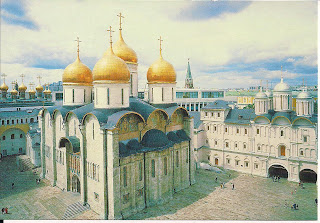
The Assumption Cathedral

   The Assumption Cathedral has five golden helmet domes and four semicircular gables facing the square. This was the focal church of pre-revolutionary Russia and burial place of most of the heads of the Russian Orthodox Church from the 1320's to 1700. In 1812, French troops used it as a stable and looted 295 kg of gold and five tonnes of silver, but much of it was recovered.

Entrance to the Assumption Cathedral
 
   Beside the western door of the Assumption Cathedral sits the Church of the Deposition of the Robe, which was built between 1484-6 as a private chapel.

   Just to the south is the Ivan the Great Bell Tower (Kolokolnya Ivana Velikogo), the Kremlin's tallest structure. It is visible from 30 km away, and before the 20th century, it was forbidden to build any higher in Moscow.

Ivan the Great Bell Tower
 
   In front of this cathedral are the Tsar Bell and the Tsar Cannon. The former is the world's largest bell, a 202 tonne monster that never rang. It was cast in the 1730's for the Empress Anna Ivanovna. As it was cooling off in a foundry casting pit, water being poured to cool the fires nearby came into contact with the bell, causing an 11 tonne chunk to fall off.

Tsar Bell
 
   The cannon was cast in 1586 for Fyodor I, whose portrait is on the barrel. The bore is 89 cm!

Tsar Cannon
 
   The Archangel Cathedral is on the square's south-eastern corner. It was formerly the coronation, wedding and burial church of the tsars. The tombs of all of Muscovy's rulers from the 1320's to the 1690's are here (except one: Boris Godunov).

   Ivan the Terrible lies here, but his tomb is out of sight behind a wall of icons, as are the tombs of two of his sons: Ivan (whom he killed), and Fyodor (who succeeded him). From Peter the Great onward, emperors and empresses were buried in St. Petersburg.

   The Annunciation Cathedral (Blagoveshchensky sobor) at the southwestern corner of the square has what are described as the "greatest icons by the greatest icon painter, Theophanes the Greek."

   Icons are depictions of saints and other characters from the Bible. Some of them are indeed quite beautiful, but the multitude that are on display in these and other churches can lessen a person's appreciation for what he is seeing.

   The one other sight to see in the Kremlin is the Armoury (Oruzheynaya palata), which houses a vast array of the treasures accumulated by the tsars.  There are nine rooms: rooms 1 to 5 are upstairs, 6 to 9 downstairs.

   Room 3 has the renowned Easter eggs of precious metals and jewels by the St. Petersburg jewelers Faberge.

   Room 6 contains thrones and royal regalia, including the 800 diamond throne of Tsar Alexey, the jewel-studded, sable-trimmed gold Cap of Monomakh, and the coronation dresses of 18th century empresses.

   Room 9 holds many coaches, including the sleigh that Empress Elizabeth rode from St. Petersburg to Moscow for her coronation. It was pulled by 23 horses at a time - about 800 in all for the whole trip.

The Great Kremlin Palace

   Between the Armoury and the Annunciation Cathedral stretches the 700-room Great Kremlin Palace (Bolshoy Kremlyovsky dvorets), built in the period from 1838 to 1849 as an imperial residence. It's now the official residence of the Russian president and is used for official state visits and receptions. It's not open to the public.

   Once I was finished seeing all these sights, my day in Moscow was just about done. I had planned to cap it off with a visit to the Moosehead Canadian Bar, but it had been closed and reopened as a milk bar! I had to settle for a steak at the American Bar and Grill. I made my way back to my hotel, and packed for the next (and next to last) destination on my round the world jaunt: Poland.

Tuesday, August 21, 2012

Audiobooks

I used to listen to audiobooks quite a lot. After I bought a car in Korea, I needed to listen to something other than the radio, which oddly enough was in a language foreign to me.
The noises that passed for pop music over there caused me to  bleed from the ears, and eventually my head would explode in a welter of gore. If I didn't want to end up cleaning the car like Vince and Jules, I needed an alternative to K-Pop.
So I bought an iPod, and filled it with my kind of music. And then I had the idea of adding books so I could listen to them, too. I think my favourite books to listen to were the Harry Potter's read by Stephen Fry. It helps if the person reading the book for you has a good voice, and Fry's is delightful.
I remember the episode of "Seinfeld" where George gets an audio textbook because he can no longer sit down and read a book. The audio textbook is read by someone with a voice that sounds like George's own, however, high and whiny. Oh well.
I also listened to books by Churchill, Dashiell Hammett, Dickens, and P.G. Wodehouse. I listened to Dracula, I, Claudius, The Lord of the Rings, and War and Peace.
It was great, but I don't listen to audiobooks anymore. I think I burned myself out on them, besides having the misfortune to have the reader's voice turn out to be as bad as George Costanza's.
There were three sets of audiobooks that finally soured me on them.
The first was the five books that (so far) make up the "Game of Thrones" saga. I really enjoyed the mini-series, despite some facebook mook revealing the ending. So I downloaded the rest of the series from Demonoid and set about finding out what happened next.
As I said, the reader had a really annoying voice. His Khal Drogo sounded like one of those B-movie Russian commie villains, and not at all very heoric. His women were even worse. About as sexy as Keith Richards' voice.
The best voice he did was for the crow mascot of the Black Knights on the Wall. He did that croak very well.
But I persevered, and tried to make sense of what was happening in Westeros, and what might happen next. SPOILER ALERT! I centred on Eddard Stark's son as the "hero" of the tale, and I figured he would be the final victor until I listened to the the disaster that befell him and his mother at the Red Wedding.
That episode really took me by surprise, and I don't think I've recovered from it even yet.
The next set of books I listened to was the "Hunger Games" trilogy. I had never even heard of them until last fall, when a classmate told me how excited he was for the movie to come out. I took his enthusiasm for the book as a recommendation and downloaded the series.
The first book was okay, but it had the disadvantage of being read by a woman with the most unctuous voice imaginable. And the second book had a lot of mooning about by the main character, a teenaged girl. She was unsure about which boy she loved more, and spent a lot of time agonizing over her choice. I started to think of this series as another version of "Twilight." That was enough to put me off right there, but I soldiered on and eventually finished the series.
I can just about tell you what happened.
The third book that did it for me was Stephen King's "The Stand," which I really enjoyed reading when it first came out. The audio version was another matter. The reader had an annoying habit of mispronouncing words and names. For example, Nadine didn't come out as "Nay-deen," but as "Nah-deen," and so on.
I got so fed up that I didn't even finish listening to the book, and I haven't even thought about listening to a book from that day to this. Maybe some day, but when? Who can say?

Monday, August 20, 2012

A Mystery

Sundre is a town on the edge of the foothills. There is a lot of wildlife around. Deer roam through the town, eating roses out of people's gardens. There're even reports of bears on the outskirts, so a person has to be careful when going out for a walk on the trails down by the river.
Every once in a while, I hear a pack of coyotes howling at the moon, and I think about the dogs in the town. Most of the dogs I see are those little lap dogs. Not too many of the larger variety around.
The mooks across the alley from my folks got a little dog a few weeks ago. It was a little noisy, but not annoyingly so. It reminded me of Frisky, the pup in a coupla Waner Bros. cartoons. He was introduced into the household of a corpulent,complacent cat called Claude (nice alliteration, eh?).
Just when Claude would start to relax, Frisky would come out of nowhere, barking excitedly, sending Claude up to the ceiling.
But, I digress.
The mooks didn't have a fence at the rear of their property, so they jury-rigged a flourescent orange net to keep the pup in. He would bark at people who passed by, and one or another of the mooks'd come out and yell at it to be quiet.
A few weeks after the dogs' appearance, I saw one of the mooks taking it for a walk. The "fence" had been folded back. I guess that was their version of a "gate."
A coupla days later, I saw the dog running around loose, I think with another dog or two, and I wondered if the mooks were just letting it roam the neighbourhood, pooping wherever instead of their back yard.
About the same time, maybe even the same day, late at night, the coyotes set up such a racket of howling, yowling and savage barking that I figured they must have been having their version of a gang fight.
And ever since that day, the mooks' dog hasn't been seen or heard from.
Did the mooks get tired of the dog?
And let it get eaten, rather than take care of it?
I wouldn't put it past them. They are mooks, after all.
But that's just speculation on my part. I witnessed a series of events, and came to a conclusion. Not neccessarily the right one, but one that fits the circumstances.
As I said, a mystery.

Thursday, August 16, 2012

A Cathedral and a Corpse


World Adventurer (November 21, 2003 Chautauqua)

Red Square, featuring (from left to right):
The GUM Store (barely visible),
St. Basil's Cathedral
The Spasskaya Tower
Lenin's Tomb
and the walls of The Kremlin


    Tuesday, May 6th, was grey, wet and rainy in Moscow as I stood at the entrance to a 400 by 150 metre area so central to Russian history, Krasnaya Ploshchad - Red Square.

   It lies immediately outside the northwest wall of the Kremlin.  I entered from a street called ulitsa Nikolskaya. To my right was the Resurrection Gate (Voskresenskiye Vorota), which was rebuilt in 1995. It is an exact copy of the original completed on this site in 1680. The original was torn down in 1931 because Stalin thought it was in the way of the parades and demonstrations held in Red Square.

   To my left was the GUM store. I passed through the concrete barriers and stepped onto the cobblestones of a place very far away from my Canadian prairie home. The square is closed to vehicular traffic, except for government limousines.

   The name Red Square has nothing to do with either communism or the blood that has flowed here. Krasny originally meant beautiful: only in the 20th century did it come to mean red, too.  The place used to be a market square, and has always been the place where the Kremlin's occupants made several important statements to their people.

   Ivan the Terrible publicly confessed his misdeeds here in 1547, built St. Basil's Cathedral to commemorate his victories in the 1550's, and later had numerous perceived enemies executed here.

   The Cossack rebel Stephen Razin was dismembered here in 1671.

   In 1698, Peter the Great had 2,000 members of his palace guard, the Streltsy, executed en masse. The spot is marked by a round, walled Place of Skulls (Lobnoe Mesto).

   Soviet rulers chose Red Square for their twice-yearly military parades. In November 1941, they held one in which the tanks rolled straight off to the front line outside Moscow.

   During the cold war, lines of ICBMs rumbled across the square to remind the west of Soviet military might. The leaders of the Soviet Union reviewed these displays from the top of Lenin's Tomb ( a practice begun by Stalin).

Lenin's Tomb


   Made of red granite, the tomb stands at the foot of the Kremlin wall. Lenin has remained on display here since 1924, apart from some time spent in the Urals during World War II. From 1953 to 1961, he shared his tomb with Stalin, until Krushchev had him removed. There is some talk of having Lenin removed, as well, and having him interred somewhere more appropriate, but no-one is willing to provoke the hard-liners who want him just where he is. There is also some talk of whether the body is real, or just something you might see at Madame Tussaud's Wax Museum. I cannot give you my opinion, as the tomb was closed when I was there, as was the Kremlin wall, where many worthies are resting, including:

Felix Dzerzhinsky, the founder of the Cheka (forerunner of the KGB)

Yakov Sverdlov, a key organizer of the revolution

Inessa Armand, Lenin's lover

John Reed, The American author of a first hand account of the revolution, Ten Days That Shook The World

Yuri Gagarin, the first astronaut

Marshal Georgi Zhukov, the commander who defeated Hitler.

   Preparations were under way for the celebration of V-E day on Thursday, with many guards around overseeing the workers setting up seating for dignitaries, and barriers to hold back members of the public.

St. Basil's Cathedral


   I proceeded south, towards a building that everyone visualizes when you say Russia, St. Basil's Cathedral. The cathedral was partially covered with scaffolding while I was there, so I did not get a complete appreciation of the multi-coloured, multi-shaped domes. To some, they suggest something from the Orient, but they are the culmination of a wholly Russian style that had been developed in building wooden churches.

   St. Basil's was created between 1555 and 1561, replacing an existing church, to celebrate Ivan the Terrible's taking of the Tatar stronghold of Kazan on October 1st, 1552. This was the day of the feast of the intercession, hence its official name, the Pokrovsky (Intercession) Cathedral. The architect is thought to be Posnik Yakovlev, who was blinded by Ivan so that he could never build anything comparable.

   The cathedral owes its usual name to Vasily (Basil) the Blessed, the barefoot holy fool who predicted Ivan's damnation and added (correctly) that the day the army left for Kazan, Ivan would murder one of his sons. Vasily died while Kazan was under siege, and buried in the church which St. Basil's soon replaced.

The cathedral from the south


   The many domes are arranged over nine main chapels: the tall, tent-roofed one in the centre; four big, octagonal towered ones, topped with the four biggest domes, on the north, south, east, and west; and four smaller ones in between. A couple of extra tent roofs were added over the stairways, and another on the north-eastern chapel over Vasily's grave.  Only in the 1670's were the domes patterned and St. Basil's given its present, highly colourful appearance.

   The interior is fairly close, and gives the impression of great age. The walls are painted cement except for the areas in the chapels that have icons displayed. The ceilings under the domes go up quite high. There is a model of the cathedral in the entrance lobby.

   Out in front, there is a statue of the butcher Kuzma Minin and Prince Dmitry Pozharsky, who together raised and led an army that ejected the occupying Poles in 1612.

   My steps now took me towards the place where all Russian roads eventually lead, and where all political power emanates from, The Kremlin.

The Spasskaya Tower

Thursday, August 2, 2012

The Big Village


World Adventurer (November 7, 2003 Chautauqua)


    Moscow is the capital of Russia, and has a population of about 9 million people. The centre of government is the Kremlin, a red-brick walled fortress where the city has its beginnings.

   The area was probably first settled during the 10th or 11th centuries. In the following years it was the site of many battles between the natives and the Tatars, descendants of Genghis Khan's Mongol Horde. Eventually, Moscow became the centre of power, and began to expand into the surrounding areas. It was not until the 15th century, however, under a prince known as Ivan III (the Great) that they were able to free themselves of the Horde's influence. Ivan rebuilt the Kremlin, bringing in Italian architects to design new cathedrals.

   Ivan IV (the Terrible) greatly expanded Moscow's power east into Siberia and south to the Volga. By 1571, the population was about 100,000, one of the largest in the world. There followed a "Time of Troubles:" false tsars, civil wars, invasions, and Moscow being occupied by the Poles, before 16-year-old Prince Mikhail Romanov was elected Tsar. He founded a dynasty that ruled for over 300 years.

   Peter the Great built a new capital, St. Petersburg, on the Baltic to open up Russia to new ideas from the west. He disliked Moscow, as do most St. Petersburgers, who think of it as "just a big village, not a real city."

   It was important enough to be Napoleon's main goal in 1812. After his troops began their occupation, though, a fire broke out that burnt most of the city, including the food. The French had to pull out after only one month. Moscow rebuilt itself, and replaced the defensive works with tree-lined boulevards and parks.

   Fearing the occupation of St. Petersburg by the Germans, the revolutionary government moved the capital back to Moscow in 1918. Stalin began a comprehensive rehabilitation campaign, building many broad thoroughfares, demolishing half of the city's artistic and historical landmarks, and erecting seven great, grey neo-Gothic skyscrapers called, the "Seven Sisters."

One of the "Seven Sisters"

   The Nazis came close to Moscow during World War II, and a huge monument marks the spot, just outside the international airport Sheremetevo-2.

   After the war, huge housing projects were built. Planners shifted to building high rises in an attempt to keep the area of the city within its outer ring road.

   Since the fall of communism, these housing and state businesses have been sold off, and the old system of street names has been restored. There has been a great influx of luxury goods, advertising, bright lights, casinos, restaurants, and night life. It is an interesting mix of "new Russians," enjoying the spoils of capitalism in one of the most expensive cities in the world while the majority remain among the lowest paid. This is where I woke up on the grey and rainy morning of May 5th.

   Before I could enjoy the sights of the city, I had to worry about getting out before my visa expired. I went to a travel agency recommended by the "Lonely Planet" guide, called "Infinity Travel." They were very helpful, and got me some cheap flights to Poland, and then from Poland to Canada.

   After that, I headed to the centre of town to take in what I thought were the most important sites to see.

   I traveled around Moscow via the subway, which is a something to see in itself. The first station opened in 1935, and much of the early work was overseen by Nikita Khrushchev, who drove the workers as hard as possible, and more. Nowadays, as many as nine million people ride every day, more than London and New York combined. The first stations were dug very deep, so that they could double as bomb shelters. After someone realized you couldn't dig deep enough to escape a rain of American missiles, stations were built closer to the surface.

   Some of the deepest are quite an experience to get to, riding an escalator that goes down five stories. Once on the platform, riders can enjoy great artwork before their trains arrive. The Komsomolskaya station has mosaics of Russian military heroes (as well as the heroic metro workers).  There are chandeliers to light the way. The Mayakovskaya has a central hall that is all stainless steel and marble (it won a prize at the 1938 World's Fair). The Novokuznetskaya has military bas-reliefs and ceiling mosaics, and the Ploshchad Revolyutsii features life-size bronze statues that illustrate the idealized roles of common men and women.

   My first stop was Lubanskaya Ploshchad ("ploshchad" means "square").

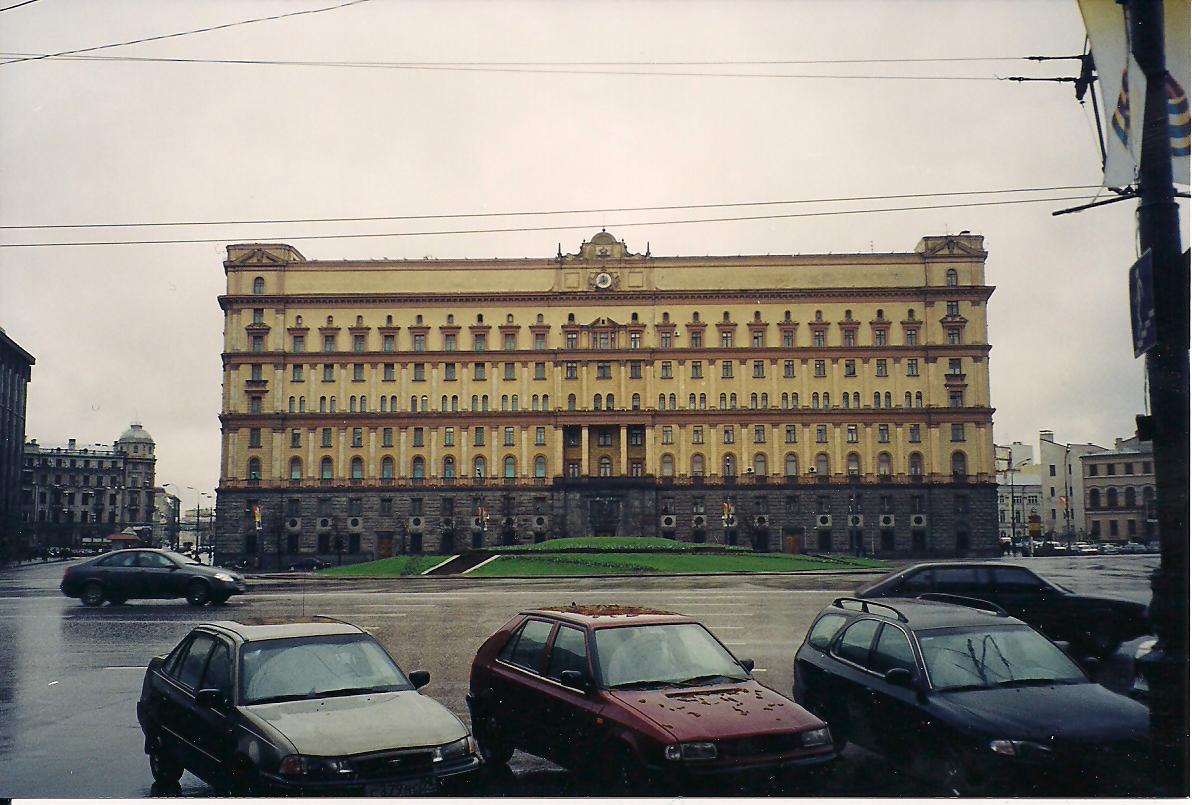
The Lubyanka

   This is where the Lubyanka Prison is situated. The Lubyanka was formerly the headquarters of the Komitet Gosudarstvennoy Bezopasnosti (Committee for State Security), or KGB. This is where enemies of the  Soviets met their fate. From 1926 to 1990, this square was known as the ploshchad Dzerzhinskogo, after Felix Dzerzhinsky, the KGB's founder. A statue of him dominated the square until it was removed by a mob in 1991.  There is now a humbler "Memorial to the Victims of Totalitarianism" in a little garden in the south-eastern corner.

   I left this area by a street called "Nikolskaya ulitsa," which passes through a neighbourhood called "Kitay-Gorod" (Chinatown). There is nothing Chinese about it. "Kita" refers to the wattling, or palisades, that reinforced the earthen ramp that used to surround the area. This is one of the oldest parts of Moscow, settled since the 13th century, and long a trade and financial centre. It ends by passing between the GUM and the Kazan Cathedral.

Kazan Cathedral

   The GUM, or Gosudarstvennoy Universalny Magazin (State Department Store) was to my left (southwards). It was built in the 19th century to house over 1,000 shops. GUM once symbolized all that was bad about Soviet shopping - long queues to look at empty shelves. It is now bustling with all manner of consumer goods.

The GUM store, with VE Day posters

   The Kazan Cathedral was originally erected in 1636 in thanks for the expulsion of the Polish invaders. It was a highly popular symbol of Russia's survival until Stalin had it torn down so that it would no longer impede the parades that were held in celebration of the workers and the revolution. It was rebuilt in 1993.

   The day was still quite grey, windy, and wet as I stood at the entrance of a 400 by 150 metre area so central to Russian history, Krasnaya ploshchad - Red Square.


Monday, July 23, 2012

From the Urals to Moscow


World Adventurer (October 17, 2003 Chautauqua)

    On the sixth day of my rail journey across Russia, I was looking forward to arriving in the capital, Moscow, the next day, Sunday, May 4th.

   The train was in western Siberia, only two hours ahead of Moscow time, closing in on the Ural mountains, the dividing line between Asia and Europe.

   Before that, we would stop in Yekaterinburg (1,818 km from Moscow), one of the places I almost broke my journey at. There is a lot of history there.

Ekeratinburg (Sverdlovsk) terminal

   The city was founded as a factory-fort in 1723 by Peter the Great, who was determined to take advantage of the area's mineral resources, and the name of the town reflects that - Catherine is the Russian patron saint of mining. At one time, the town was also named for Peter's wife, but this was "overlooked" after Peter discovered she was unfaithful, and had her executed.

   The town became a big industrial centre, supplying the local mines with machinery.

   In July 1918, Tsar Nicholas II and his family were murdered there by the Bolsheviks after being held prisoner for a short time. Shot to death in the basement of a house, their bodies were thrown into a mine.  Their killers attempted to destroy the evidence with grenades and acid, but the bones were found in 1991, and interred in St. Petersburg in 1998.

   In 1924, the city was renamed Sverdlovsk, after the man who had arranged the murders. The city grew during World War II, with the influx of many war industries. Sverdlovsk was off limits to foreigners until 1990.

   In 1960, U2 spy plane pilot Francis Gary Powers was shot down near there, wrecking the Paris Peace conference. He was tried and held as a spy before being exchanged back to America in 1962.

   In 1979, a chemical leak from biological weapons plant Sverdlovsk-17 caused 64 deaths.

   The city took back its original name in 1991, though many people (as well as some rail timetables) still refer to it as Sverdlovsk.

   Its latest claim to fame is that it is the "home town" of former President Boris Yeltsin. He was born in a small town 190 km to the east, and studied civil engineering at Yekaterinburg's technical university. He was the foreman, and then the head of the house-building organization before joining the Communist Party, becoming regional head in 1976. He was popular, and was promoted to head the Moscow Party in 1985.

   In 1991, the old guard of the Party attempted to oust Gorbachev, and it was partly due to Yeltsin's rallying of the people to resist that helped it fail. Elected President, he had a colourful (to say the least) tenure before stepping down in 2000.

Terminal exterior

   The train arrived in Yekaterinburg about 4:14 PM, just as a cloudburst drenched the platform. Our stop was scheduled to be a long one, and I took the opportunity to go out into the street to have a look around. The city was a lot bigger and more modern that I had imagined.  The station itself was a work of art, with a lot of marble and cut glass chandeliers in the foyer.

Terminal interior

   I bought a bottle of vodka from a vendor on the platform, who showed me how to hide it under my coat. I guess the providnitsa's look out for this, and confiscate from any offenders.

   We were all standing around the platform, getting the last kinks out of our legs before we took off, when the train started moving! A mad rush, and everyone was aboard safely. Whew!

   We travelled through the Urals from the 1,900 until the 1,600km marker, but they sure were nothing to write home about. They just looked like a lot of rolling hills to me. Pretty countryside, though.

Passing through the Urals

   The 1,777 km marker is a large white obelisk, and this marks the dividing line between Asia and Europe. The vodka I had bought helped in our celebrations of the event.

The divider between Asia and Europe

   That evening, we passed through Perm (1,433 km from Moscow), which is best known as the model for the town of Yuriatin in the book "Dr. Zhivago," and for a series of UFO sightings in the 1980's. This is another defence industry city formerly closed to foreigners. One of the local attractions is an old Stalin-era prison, Perm-36.

   At the 1,356 km marker, we passed into another time zone - only one hour ahead of Moscow.

   The next day, there wasn't too much to do besides last minute packing. My Japanese travelling companion, Masako, had reservations at a hotel close to the train station, so I decided to string along and see if there was room for me, as well.

   At 10:00 AM, we stopped in Nizhny Novgorod (500 km from Moscow). Founded in 1221, it was renamed during Soviet times for the writer Maxim Gorky. It is Russia's third largest city (pop. 1.5 million), and is a big economic centre. Many firms co-operate in joint ventures with western firms.

   The famous dissident, and Nobel laureate, Andrey Sakharov was exiled there until 1986.

   It was there that we crossed the Volga River, one of the world's longest (3,700 km). It only falls a few hundred metres, so it was mostly slow and majestic until some 1930's hydro-electric projects turned it into a series of stagnant reservoirs. Sewage and other types of pollution are doing great damage to the sturgeon that produce caviar, and causing many beach closures.

   At 2:00 PM, we stopped for the last time before our final destination, in Vladimir (125 km from Moscow), which was founded in 1108 as a fort, eventually becoming the capital of the territory known as the Kyivan Rus. It was devastated during wars with the Tatars, and recovered each time, but its importance gradually became eclipsed by Moscow's rise.

   There is a wonderful old steam engine at the station, and a beautiful church - St. Dmitry's Cathedral - on hill overlooking, but our stop didn't allow much time for exploring.


   The countryside had changed dramatically since Siberia. There were now many farms and towns, giving the scenery a settled look. Going through more populated regions, there was a lot of filth and refuse, and even what looked like a "tramp city," with down-and-outers living in whatever they could patch together for shelter. The ground was still quite wet everywhere as we approached Moscow.

   I was thinking about two would-be world conquerors, Napoleon and Hitler. The former had taken this city, but he did not hold it long. The latter was stopped just short of winning the battle for Moscow, and so he lost the war. Now here was a kid from the Canadian prairies, following in their footsteps.

   There was a lot of city to go through before we arrived at Yaroslavsky Station (0 km from Moscow). It was raining, and my goodbyes to the two Aleks and the other passengers I had gotten to know were a little rushed. The providnitsa gave me the pin from her uniform, the logo for the train. I gave her and her companion some little souvenirs of Canada, which seemed to touch them a little. Then it was down the platform to the station proper, and then to the subway to the hotel - the Izmailia - which overlooked a former royal hunting reserve. That evening was spent resting from the trip, eating some real, hot food, and re-establishing contact (via e-mail) with the world. The next day would be given over to exploring the Russian capital.

The view from my hotel: Moscow!

Monday, July 9, 2012

A Dream of the Rodina


World Adventurer (October 3, 2003 Chautauqua)

   Regular readers of this column are enjoying (I hope) my tale of a rail trip across Russia. As I write these words, I am once again living and working in Korea, in the city of Pohang. I arrived here on August 26th (my birthday) to once again bring the wonder and excitement of the English language to the children of "Wonderland" school.

   Pohang is a relatively small city, by Korean standards, a little over half a million people. It's main industry is steel-making. The plant is a small city itself, stretching many kilometres southwards. As it is on the coast, there is access to some fine sandy beaches.

   In my last column about life in Korea, I was describing the match-making that goes on before a typical wedding. I had promised to follow up with a story about how a traditional Korean wedding takes place, but I was forced to forgo that, as I had not completed my research. I now have that research in hand, and I am ready to tell that story. We will get to it, just as soon as I complete my "saga" of my trip across Russia, and my adventures in Poland.

   I had reached the half-way point in my journey, and the Aleks and I thought it would be a good idea to start mixing our drinks. We started with beer (pronounced "pee-va" in Russian), and continued with vodka, the ubiquitous part of any Russian's lifestyle.

   Alek (no, the other one) had a bottle of cognac to add some more fuel to the fire, and on top of all this went something that I believe they called "balsam." By the end of the evening, we were all reeling off to bed, and if their heads were as big as mine the next day, it was a wonder we were all able to fit in one compartment. The sun was waaaay too bright as we rolled into Krasnoyarsk (4,104 km from Moscow).

   During the night, we had passed over the Yenisey River, the dividing line between eastern and western Siberia. We were only four hours ahead of Moscow time. During our stop in Krasnoyarsk, not too many of us were stocking up on alcohol. I went for some water and juice, plus the usual homemade food sold by the locals.

   On our way again, we passed the 3,932 km marker, the halfway point between Moscow and Beijing.

   My compartment was now no longer the main gathering place. Alek (no, the other one) had left us the day before, and the two remaining shifted down the car to a compartment with a couple of soldiers and the Japanese girl, Masako.

   There was the usual conversation, card playing, and drinking. I took the opportunity for some quiet time in my own compartment.

A line of con-apts next to the tracks.
Kind of reminded me of Korea.


   I reflected on the scenery we were offered during our trip through towns along the way. It seemed like we were travelling through the worst sections, with trash, run down buildings, and even some encampments of what must have been homeless. These could be seen on all the train platforms, begging from the travellers. There were some pathetic little children involved in this activity as well, trying to look as needy as possible to the wealthiest-looking people they could find.

   Our own train car began to reflect a certain run-down quality, as well. There began to creep in the aroma of unwashed bodies. Everyone was a little rough around the edges as the days on the move began to mount up, laundry became dirtier, and trips to the bathroom became less frequent. Our compartment was not too bad, but just walking past some of the others could make you eyes water.

   There was some music on the train. There were intercoms in the passageway, and in each room, which brought in radio stations from each town we passed. It was an eclectic selection, to say the least. From the latest Madonna tune to up tempo "disco" to what sounded like Russian folk songs.

   We just kept rolling through the "Rodina" (motherland). Past Mariinsk (3,719 km from Moscow) and on into Tayga (3,571 km from Moscow), which has a branch line northwards to the closed (to foreigners) defence-industry city of Tomsk.

   Through these parts, the land is much more settled, with less of the endless forest, and more of the farmsteads set in what the Lonely Planet guide calls a "Cinemascope landscape."

   The great Russian writer, Anton Chekov, wrote in his essay "About Siberia," "You'll be bored from the Urals to the Yenisey. A cold valley, crooked birches, fields, once in a while a lake, snow in May on the barren cheerless banks of the Ob tributaries..." He was writing about the old post road, and some may say the description still holds true. I was still interested in watching it go past, though.

The terminal at Novosibirsk

   At the 3,488 km marker, we passed into another time zone. At the 3,332 km marker, we crossed the Ob River, one of the world's longest. Here we stopped at Novosibirsk (3,343 km from Moscow), Siberia's biggest city. Founded in 1893 because of the railway, it has grown into a large industrial city, and a crucial link between Moscow and the far east. It was 10:00 PM, soon time to turn in for the night.

   While I slept, we passed through Omsk (2,716 km from Moscow), which was the city of another great Russian writer's ( Fyodor Dostoevsky) exile during the 1850's. He had gotten involved with some revolutionaries, and been imprisoned for a time before being sent to the east. After his experiences, he wrote Crime and Punishment. His writing focussed on individual freedom and responsibility, and the infinite worth of the human soul.

   We also passed into a new time zone, and were only two hours ahead of Moscow.

   Just after 8:00 in the morning, we stopped at Yshyn. Our next stop was at 11:15, in Tyumen (2,144 km from Moscow), the oldest city in Siberia. Founded in 1586 near the site of one of the Mongol hordes old cities, it was the hiding place for Lenin's body during World War II.

   The weather had turned grey and rainy. The land was very wet and marshy. Sometimes it seemed like the railbed was the only dry ground in the country. There were still great stretches of forest in between the sometimes isolated farms. I thought I saw some snow mixed in with the rainfall.

   The trip, now into its sixth day, was nearing its end, and the time came to prepare for arrival in Moscow, but not before seeing some of the most interesting places yet.