Saturday, June 16, 2012

The Trans-Siberian Railway

World Adventurer (August 15, 2003 Chautauqua)

   The Trans-Siberian Railway is the world's longest, and most impressive, train ride. It crosses eight time zones, covering 9,289 kilometres through taiga, steppe, and desert.


   There are three different main lines and numerous trains running on what is generically called the Trans-Siberian. I had chosen to ride from Vladivostok to Moscow, but you can also travel through Mongolia and China.

   The main line starts from Yaroslavl station in Moscow, departing every other day on a 6 and a half day journey. The Trans-Mongolian follows the main route as far as Lake Baikal, where it turns south to reach the Chinese capital of Beijing via Ulan Bataar, the capital of Mongolia.

   The Trans-Manchurian leaves the line further east, at Tarskaya, to reach Beijing via Harbin and northeastern China.

   Russia's initial conquest of Siberia was via its rivers, but the burgeoning population and the covetous eyes of neighbours pointed out the need for better communication links.

   The Americans had completed their railway in 1869, and we Canadians had done it in 1885. The Russians finally began theirs in 1891.  The right of way was cut through and across taiga and steppe with hand tools. The work force was made up of convicts, imported Chinese, exiles, and soldiers. Thanks to the terrain, climate, floods, landslides, disease, war, bandit attacks, and not to mention bad planning, it took 26 years to complete. It remains a brilliant feat of engineering. The railway was divided into six sections so that work could be done simultaneously.

   For the longest time, the hole on the track was around Lake Baikal. Trains were taken across by ship, and tracks were laid across in winter, when the lake froze. The initial test of this track met with failure, and a hole 22km long was left where there had been a train. The Russians merely disassembled the trains and pulled them across with horse power.

   It was finally possible to travel from one end to the other in 1904, via a line through Manchuria.  The last link was finished in 1916, a bridge over the Amur River at Khabarovsk.

   The railway came to be the major link that held Russia together through years of war and revolution. Even the rise of air travel and the demise of the Soviet system has not diminished its importance. There is still no road that cars and trucks can take through Siberia, and rail remains the only viable option for heavy freight.

   For the first four days travel out of Moscow, all three lines follow the same double-track main line through the Urals and into western Siberia, over the Yenisey River (which marks the border of eastern Siberia) and on to Irkutsk. The fifth day sees the train rounding the southern tip of Lake Baikal. This is where the Trans-Mongolian branches off, heading for the border 250 km away. The Trans-Manchurian stays with the main line for another 12 hours, until it too heads south-east for Zaibaikalsk, 368 km distant.

   Every carriage has a timetable in Cyrillic, the Russian alphabet. I got pretty good at deciphering the place names, so that I could tell when we were approaching any significant stops.  This is important if you want to eat and drink cheaply. The timetables are not set in stone, and a stop may be shortened if the train is running late.

   The provodnik or conductor, will usually keep an eye out for the passengers riding in his/her car, and herd them aboard when departure time rolls around.

   Usually the train stops for about 15 or 20 minutes, allowing time to stretch the legs and raid the kiosks for food. There are small white kilometre posts along the railway line, marking the distance from Moscow.

The Vladivostok Terminal

   My Vladivostok travel agent picked me up at my hotel, and took me down to the train station for the 5:30 PM departure time.

A local Vladivostok commuter train

The Trans-Siberian's locomotive

West-bound train on the left,
east-bound on the right.

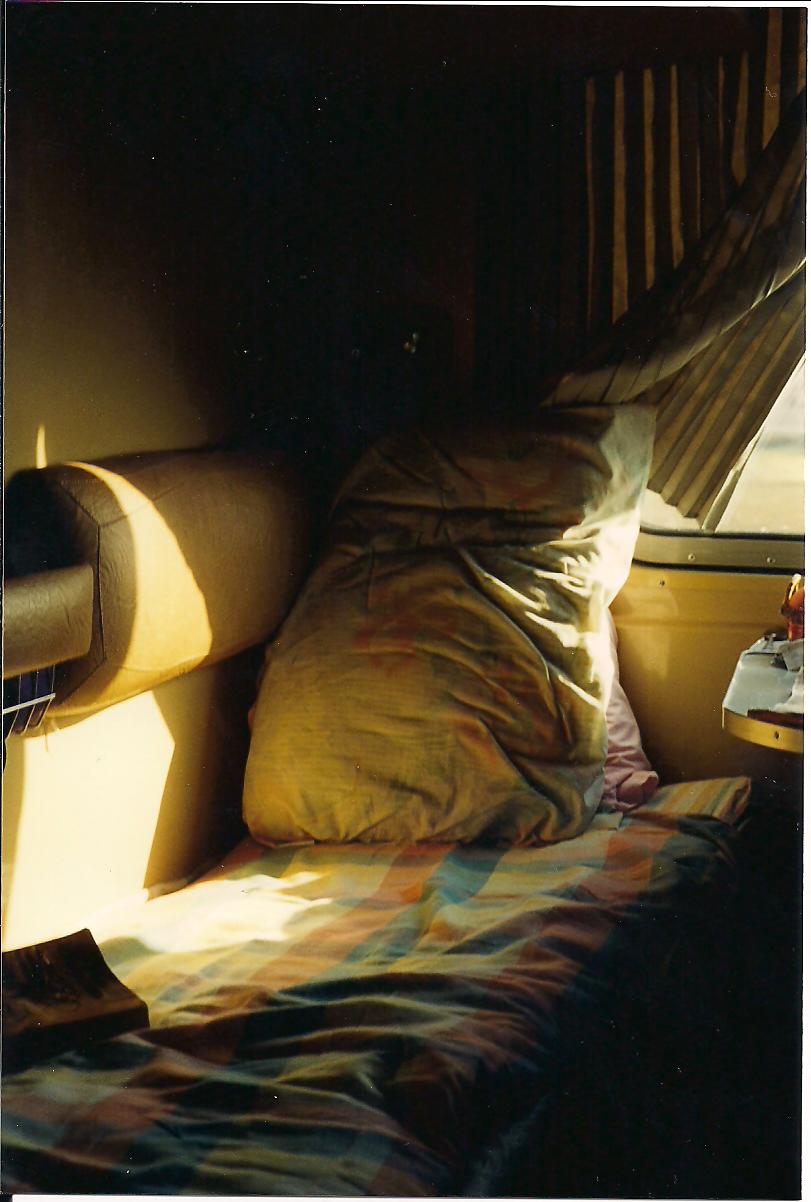
   The train itself is very colourful. It is painted to resemble the Russian flag: white on top, then blue and finally red. Each car has the name of the train "Russia" (in Cyrillic) emblazoned at the top. My ticket cost 6, 045 rubles (about $200 US). I boarded car 20, and met the providnitsa, the two (female) attendants, who would work 12 hour shifts, turn and about, to look after everyone on the car.    I was taken to compartment VIII, which had four berths. It was fairly narrow, but there was more than enough room for my two bags in a bin under my berth.  Anyone trying to steal my stuff while I slept would have to lift up the place where I was sleeping.


   My berth was number 17, which was the lower one towards the front of the train. It meant that, while sitting, I would be facing towards the places we had come from. Jerry Seinfeld enjoys sitting like this. He says it's like going back in time.

   I was alone in the compartment when the train departed (bang on time), and I amused myself by watching Vladivostok pass by. Soon we were heading north, with Amursky Bay on the left, and rolling farmland on the right.

The train leaving Vladivostok
   The "Lonely Planet" guide warned me to beware of the dining car's high prices and poor quality, but I nevertheless made my way there for my first meal. I was seated at a table with another gentleman, who introduced himself as Alec (or Oleg). We chatted while I ate, and I counted myself fortunate to run into someone who spoke English. After a bit we retired to my compartment to imbibe a little of the local vodka. We found another passenger installed in the bunk opposite mine. He was an older gentleman, and his name turned out to be, coincidentally, Alec. He had no English, but the first Alec was happy enough to act as translator.

   Soon it was time to retire. The providnitsa had supplied sheets, a pillow, a blanket, and a towel (for a nominal cost). I had brought my own, but was unable to face up to the formidable "Russian" face when I was asked to fork over the bread.

   I was awakened during the middle of the night by the arrival of another passenger, who was making up one of the upper berths. In the morning he introduced himself as - Alec. I had met three Russian men on this train, and all three had the same name.  

   This was going to be a very interesting trip.

Wednesday, June 13, 2012

News

I don't really watch the news anymore. It's hard to take them seriously after a steady diet of "The Daily Show."
So I only half listen when it's on someone else's TV.
I overheard a real gem last week, when Global was reporting about the "Canadian Psycho," Luka Magnotta (and don't think we're not proud about THAT).
She said that he "was behind the discovery of body parts sent to Montreal schools."
Doesn't that mean he was helping out the police looking for the body parts?
And not responsible (or "behind") sending the parts?
I know, I know, she was just reading what was on the teleprompter, and not thinking about what it said. That's somebody else's job, thinking. And writing, that's not her responsibility, either.
Allan Fotheringham used to refer to TV newsreaders as "teeth and hair."
Heh.
The other interesting thing I heard last week was on Fareed Zakaria's show, when he was talking about the differences in Canadian and American immigration policies. He was suggesting that Canada was more open to accepting people from abroad than the U.S., and he pointed to the example of Calgary's mayor, Naheed Nenshi, a Muslim whose parents immigrated to Canada from Tanzania. The U.S. denied entry to a software designer from India, who went back home and came up with a program that made hime a millionaire.
So there.
Flint and I have written extensively about our experiences abroad, so it's obvious we know what it's like for somebody going to a strange country, looking for a better future.
This is something that I've thought about a lot when I consider what kind of teaching I want to do when I graduate next year. I'm focusing more and more on ESL issues, and I will be working in that field, either here or abroad, trying to help my students make a better life for themselves, and a better world for us all.  

Monday, June 4, 2012

Vladivostok: "Lord of the East"


     World Adventurer (August 1, 2003 Chautauqua)


   The home to Russia’s Pacific Fleet had been closed for more than 30 years, and these days the fleet is a rusting relic of the past. The city is open for business, though, and the tourist trade is picking up.

   Founded in 1860 during Russia’s colonization of the area east of the Amur River, Vladivostok became the fleet’s home after Japan seized Port Arthur during the Russo-Japanese war. Tsar Nicholas II paid a visit in 1891, inaugurating the Trans-Siberian railway line. Korean and Chinese labourers helped build the city, accounting for four out of five of its citizens. French, German, and Swiss speculators helped turn the city into a boom town. Japanese, American, French and English troops poured in during the civil war that followed the 1917 revolution, helping to support the tsarist counterattack. Soviet forces eventually gained the victory, marching in to establish control in 1922. Stalin got rid of the Chinese by shooting several hundred of them as spies, and deporting the rest. The northern part of the city became a vast transit centre, the way station for thousands sent to labour camps, never to be heard from again. The U.S. consulate was forced to close in 1948, and the city was closed off entirely in 1958.


   The city has reopened since the fall of the communists, and has been striving to establish itself as a cosmopolitan tourist destination. There are many Japanese and Korean cars on the streets. As I said in my last column, the ferry I traveled on had picked up a large shipment of vehicles. The Japanese drive on the left hand side of the road, and their cars have right hand drive. All of the cars the Russians bought had this feature, and you can see them all over the streets of Vladivostok. The thing is, the Russians drive on the right hand side of the road, which must make it very interesting, to say the least. I also noticed a complete absence of traffic lights. There were very few signs. I think each driver must have to rely on one direction only: “first come, first served.”

   I docked at 9:00 AM on Saturday, April 26th, and made my way to the hotel I had decided on after checking the “Lonely Planet” guide. The hotel was named after the city, and turned out to be quite a bit more expensive than the guide had led me to believe. They were remodelling the place in an ancient Egyptian theme, with sphinxes and golden “King Tut” masks all over the place. I was happy just to relax after the trip, and the walk up from the ferry terminal. I got in touch with my travel agent, and made an appointment to meet the next day.


   After lunch, I walked around the downtown area, and saw a few museums. Down the block from my hotel is one of the central squares, featuring a statue of Lenin gesturing towards Japan. Across the street are the train and ferry terminals.  North of this square is the Arsenev Regional Museum, which offers a variety of stuffed animals and displays of city history, including one featuring one of its most famous sons, Yul Brynner.  In the gift shop, I picked up some old Soviet era pins.


   Next to the waterfront is the ploshchad Bortsov za Vlast Sovietov na Dalnem Vostoke, or the “Square of the Fighters for Soviet Power in the Far East.” Some kind of festival, featuring schoolchildren doing some folk dancing in colourful costumes was going on. There were a variety of citizens enjoying the show.


   Traveling further to the east, I came across a couple of museums dedicated to naval history. They had been established inside two naval vessels.


   An S-56 submarine, which sank 10 ships during World War II, lies on a grassy plot across the street from the Krasny Vempel, the Soviet Pacific Fleet’s first vessel. There is another military museum even further west, that is now undergoing extensive renovations.


   I was able to get a bird’s eye view of the harbour from a height above Sukhanova street. Normally, you can get there on the “Funicular,” which is a kind of trolley that goes up the 200 metre slope, but it was also under repair. Seeing the “under repair” sign can get to be quite a large part of any tour of Russia, and the seasoned traveler should be prepared.


   My last stop was the museum “Vladivostok Fortress,” which occupies a former gun battery. There are a variety of weapons and military vehicles on display outside the museum, including the guns which used to guard the harbour approaches from attack.


   Inside the museum are displays of how the battery and the city developed, from its early days to the present time. There is an English-speaking guide, and a lot of the displays feature English descriptions.  It reminded me a lot of a similar museum on Waikiki, in Hawaii. That one is run by the U.S. Army, and is very similar in its set-up. Both are very informative, but they have different surroundings. The American museum is right on the beach, with palm trees and sand all around. The Russian museum is on top of a hill, with a seedy run down neighbourhood all around. I wasn’t sure I was at the right place until I was right on top of it.  The sign directing the pedestrian is very small, and points the way between two derelict-looking buildings to a large, metal gate. There was no attendant at that time, so I pushed it open and walked on in.


   There are some other sights to see in Vladivostok, but I had no more time to take them in. After meeting with my travel agent, he guided me to the train station, where I was going to purchase my tickets for the Trans-Siberian express. He explained that I could leave on Monday, the 28th, or the following Wednesday. Not wishing to delay my departure any more, I plumped for the Monday departure, and went back to my hotel to pack. I was about to spend six days doing nothing but watch Mother Russia pass by my window.

Friday, June 1, 2012

Unfriended

I've been pissing a lot of Facebook friends off  these days.
A little while ago, one friend posted a link about a burned baby. It said if you clicked on "Like" or "Share," Facebook would donate a dollar to help with her recovery. Well, I had previously been sent an e-mail with the same appeal for help from my aunt, who has never seen a chain letter she didn't like. I had looked up the true facts about this burn victim's case, which I found here: http://www.hoax-slayer.com/burned-baby-email.html
I attached this link to my friend's post, warning him it was a hoax, and sat back and waited for his profuse thanks.
Oddly, he wasn't happy.
A few days later, he posted a general appeal to all of his friends (no one person in particular being singled out), that asked them to take him off their list if they did not want him as a friend. He had certain beliefs that he was true to, and couldn't stand to have friends who questioned his commitment, and so on.
It was an amazing performance.
He really does have a social conscience, but I wondered why he was all bent out of shape about being shown that not all the causes he supports are genuine. Wouldn't it be better to support something real? Wouldn't it be better to direct your energies to the truth than some imagined, and indeed maliciously faked, cause?
I thought so, but it seems we don't share the same idea.
Oh well.
Another friend I pissed off was my niece's boyfriend, who is a big Fishhead fan. In regard to the Stanley Cup finals, I commented that it was the Devils and the Kings, and I wondered what other teams were doing?.
Oh yeah...

Well, I thought it was funny, but he went off on a rant about how the Fishheads had been President's Trophy winners (twice), had a coach who had brought them to the Finals, and blah blah blah.
Another amazing performance. 
I must say it is gratifying when someone shows you their vulnerable spot, and your efforts to tickle their vanity is rewarded.
Hee hee hee.
My latest transgression involves mine and Flint's mutual friend, Oz.
Lately he's been posting a lot of sports related stories, trying to show what he thinks are the best and most physically demanding sports. One of them rated them according to physical demands, etc. and said that water polo is the toughest sport. OK fine, but who watches water polo?
Another post showed the 10 Best Cricket Catches. The tough part comes in when you consider these catches are made without a glove, like in baseball.
Again, that's fine, but who the fuck watches cricket?
So I commented, "Yeah okay, but explain the rules in 25 words or less."
Oz posted, "stupid comment," and I replied, "stupid game."
A couple of days later, I noticed Oz was no longer listed among my Facebook friends. No explanation, he was just gone.
I've thought a lot about what it means to be a friend, mainly because lately I seem to be having a lot of trouble hanging on to them.
I think a friend accepts you for who you are, no matter what personal foibles you have.
Philo Beddoe's pal Orville went off on him once, and said, "You're allowed to be mad at your friends, you know! That's if they are!"
Philo replied that they can, and you are.

And look at the way Jay abuses Silent Bob.
I guess some people are too sensitive, but I can't do anything about that. I've always said that if somebody doesn't want to be my friend, they can fuck off.
I think those that remain show their quality.
Nuff said.

Thursday, May 31, 2012

The Hurrieder I Go


World Adventurer (July 18, 2003 Chautauqua)

“The road goes ever on and on
Down from the door where it began…”

J. R. R. Tolkien

   My journey from Korea to Russia began on Monday, April 21st. I had dinner with my Wonderland friends the previous night, and they gave me a lovely parting gift of the one essential item I had not purchased for my trip: a roll of toilet paper.

   I took the train from Daegu to Seoul, and stayed overnight at the backpacker’s hostel.  The next morning I was at the Polish Embassy spot on 10:00 AM to apply for my visa. It didn’t take long at all, and I was hoping that the rest of the trip would go as well. Best laid plans…

   I did have a train ticket to Pusan, but it was from Daegu, and it left at 12:14 PM. I figured I would probably miss it. I went to Gimpo Airport, with the intention of flying to my destination, and picking up the rest of my trip from there on in.

   I just missed the 12:00 plane, and had to settle for the 1:00. That got me into Pusan just before 2:00, but the damage was done. I made my way as quick as I could from Kimhae Airport to the ferry terminal, where I just missed the 3:00 ferry to Japan. I was really looking forward to the trip too. This particular ferry was a hydrofoil called “The Beetle.” I was going to change the name for this trip. As a fan of the Fab Four, I was going to call it “The Beatle.” Sigh.

   I should point out at this point that all of the travel personnel I talked to were very understanding and helpful. The problems I experienced were my own fault. I over-planned a wee bit too much, and it caught up with me. Ticket agents and clerks at various tourist information booths got me out of most of my jams, and my hat is off to them.

   I was able to secure passage on the 5:00 ferry to Japan. I had taken this one, called "The Camellia,” once before. It leaves the dock at 6:00, sails across to Japan and waits outside the harbour before docking in the morning. I was traveling third class, which meant that I did not have a cabin, but shared a space on the floor with a lot of other Koreans.

             The ferry dock in Pusan Harbour. The "Camellia" is at the top right.

   There is not much to do in the way of entertainment besides sitting on the deck, watching the Sea of Japan go by, and drinking beer. (Yeah, I called it "the Sea of Japan." I know Koreans'll go crazy, but that is the term I grew up with.) I was amused to see a group of men, who were playing “Go-Stop,” accosted by one of the stewards. I didn’t understand their Korean, but it seemed like the steward was asking them, “You’re not betting, are you?”

   They replied in the negative (as each of the players stuffed various bills that had been littering the tabletop into their pants).

                                                       The ferry terminal in Fukuoka.

   We debarked in Fukuoka, Japan at 8:00 on the morning of the 23rd. It was at this point that I experienced the only serious security screening I was given during this trip. When I told the Japanese customs agent that I was only transiting Japan on my way to Russia, she gave me the “hairy eyeball,” and made me open up all my things.

   I now had to make that ferry before its scheduled sailing time of 6:00 PM. My Russian travel agent had informed me (via e-mail) that I would be met by someone from the ferry at the train station in the port at 1:00 PM. I had no contact number for the ferry, and I decided I didn’t have the time to try and get in touch with anybody else. I went ahead and caught the train, which left Fukuoka at 9:05, and got to Osaka at 10:35. I changed trains and left Osaka at 10:49.

                                                 Japanese countryside from the bullet train.

   Everything you have heard about Japanese trains is true. They are fast! The day was very gray and rainy. We zipped through the beautiful, but wet, Japanese countryside, passing lakes, mountains, and bustling cities. We finally arrived in Takaoka at 3:45. The port was an outlying suburb of this city. I figured I had about two hours to catch the ferry, and would only have to apologize for making the guy wait for 3 hours.

   The local train to the port (called Fushiki) left at 4:16, and it was full of Japanese students making their way home. My luck ran true to form, and I missed my stop. I had to go all the way to the end of the line, before going all the way back. It was now about 5:00. I could see the ferry from the train station, but there was a fair-sized railway yard in between, and it was still raining pretty good. The station-master was good enough to call me a cab, which drove me around the corner and down the street to the entrance to the pier.

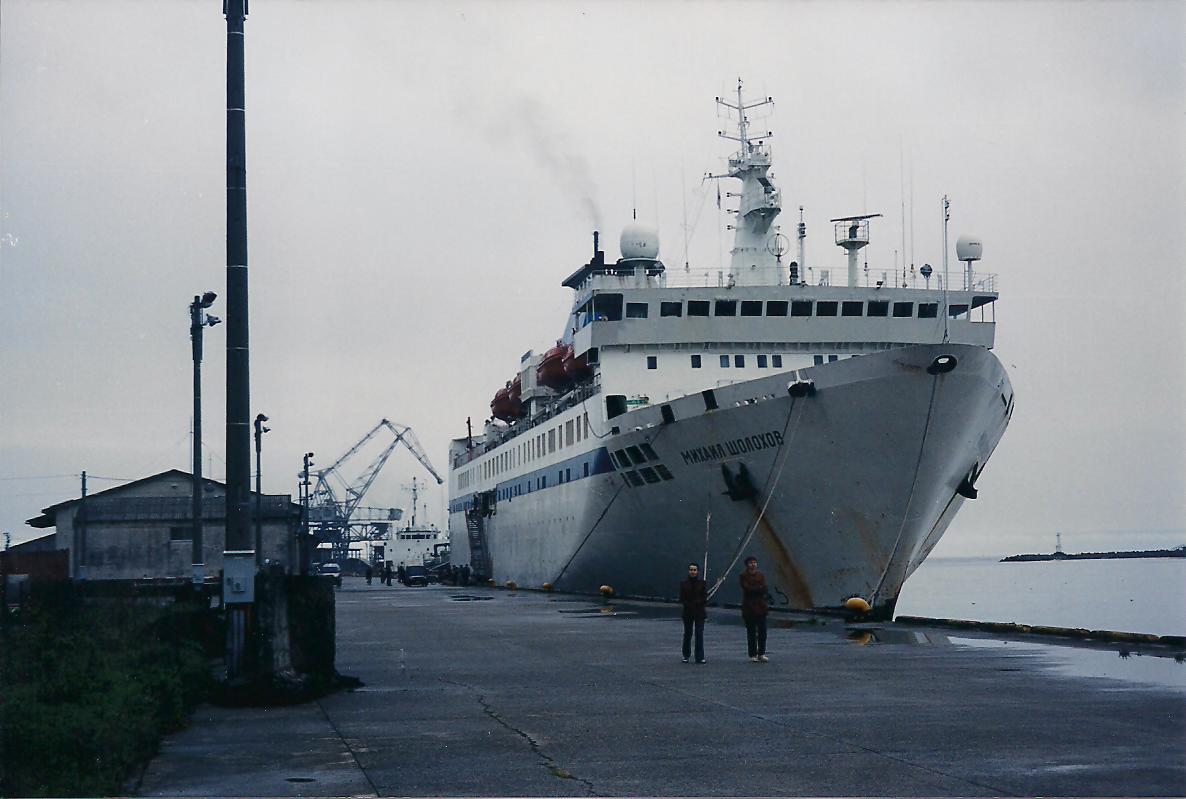
                                                  The Russian ferry "Mikhail Sholokhov."

   I made a mad dash down the pier, up the gangway, and onto the boat, just in the nick of time, I thought.

   Wrong! The trip’s pattern was holding true. I had missed the ferry, which had departed about 3:00 PM. I was aboard her sister ship, the “Mikhail Sholokhov,” which wasn’t scheduled to leave for another two days. The man who had been waiting for me looked just like the cliché Russian as he eyed me suspiciously. Who could blame him, I thought. After a little palaver with the desk clerks, and a phone call, I was told that I would be allowed to take passage on this ship.

   I did a little exploring of Fushiki (staying close to the boat, just in case). Is there anything more melancholy than a seaport in the rain? There was not much to do, and I think it was a holiday or something, as half the shops were closed. The wet weather held until we were out to sea on the 25th.

   On that day, the ferry moved from one dock to another, which was a customs area. There was a fenced in lot, where most of the passengers (big, burly men) spent the morning and afternoon buying up cars tires, appliances, office equipment, and electronics.

All these cars had to fit onto the boat somehow. BTW, Japanese don't drive on the right side of the road, so all these cars (to be sold in Russia) are right-hand drive. Almost all of the cars I saw in Vladivostok were right-hand drive, but the Russians do drive on the right-hand side.

   There was a crane that lifted up the cars onto any available deck space. It’s a good thing the weather was foul, ‘cause sunbathers would be out of luck looking for a place to lay. The only place to get out and get some fresh air and exercise was the boat deck.
Loading the cars onto the ship. Most were driven into the hold, but some had to be put on the deck.
 
This gives an idea of how crowded the deck was. There was some space where the lifeboats were, but not anywhere else. This was before "Titanic" came out, so I didn't go up to the bow and scream that I was King of the World. Well, not for that reason, anyway.

    There was not much to do on the boat, if you weren’t a Russian. The TV was in Russian, the entertainment was Russian, and the vodka was Russian. Mmmmmmmmmmmdrool.

  We finally got under way at 9:30 that night. There was a strong wind once we got moving, and the boat was soon crashing its way through waves into the Sea of Japan. (yeah, I did say it again!)

   My cabin was right on the water line, so I had a pretty good seat for the show.

                                                The view from the porthole in my cabin.
   The next day, it was announced that the ship was making 13.5 knots, and the wind was a “Force 4.” The weather started to clear, but there were still very few people going outside. The food in the dining room was pretty good. Breakfast would be a choice between “kasha” or “eggs and…” Lunch and dinner usually started with soup, followed by a hot course. The meals were served by what I soon found out was the usual sort of staff in any Russian restaurant I patronized: tall, good-looking young women.

   And so I whiled away the hours, playing solitaire, reading, and enjoying the…view, as the ship brought me closer and closer to Russia.

Tuesday, May 29, 2012

Getting Started


 World Adventurer (July 4, 2003 Chautauqua)


   It's been said that the "longest journey starts with a single step."

   The first step I took was to get in touch with a travel agent, in order to find out just how easy/difficult traveling across Russia would be.  It turns out that it would be the latter.

   I had three journeys to plan: Korea to Russia, the Trans-Siberian train, and Russia to Poland. The final leg home to Canada would be a plane trip, but the rest would be a little more involved than just booking a flight.

   Most Korean travel agents that I have dealt with are pretty good at arranging flights to the usual destinations, but they are completely buffaloed by someone (especially a foreigner) who wants to depart from the well-trodden path. The language difference can also be  a big impediment. A great deal of patience is called for.

   The first stage involved trying to find a way to book a trip on a ferry that would take me from Korea to Vladivostok in Russia, where the Trans-Siberian express begins its trek across the continent.

   Searching the net, I found a website for the "Far Eastern Shipping Company" that ran between Japan and Russia. The thing to do, it seemed, would be to purchase combination ferry-rail tickets that would cover train trips in Korea and Japan, and the ferry in between. The "Lonely Planet" gave the number for an agency that sold these tickets. Unfortunately, they were no longer in that business, but they were able to point me to one that was. The "Hong-Ki Travel Agency" in Seoul was able to book me a train ride from Daegu (in Korea) to Pusan, the ferry from Pusan to Fukuoka, Japan, and the "bullet train" from there to Kitakyushu. I would have to arrange for transport from there to the port of Fushiki, where the ferry would take me to Vladivostok.

   For the Russian portion of my journey, I dealt with a travel agency in Russia called "Voyage-Torg-Service." We were able to communicate via the e-mail quite nicely. The woman I "spoke" to, Natalia, was able to answer all my questions and make all the arrangements for that leg of my trip.

   In order to travel to Russia, you need an "invitation." This means that you have dealt with a travel agent, and you have your itinerary all sorted out. You have been issued a form outlining your trip, where you are staying, etc. You have to take this form, plus your passport to a Russian consulate in order to get a visa.

   The nearest Russian consulate was in Pusan, and I was able to have a Korean, well versed in the ins and outs of the process, help me deal with the red tape. The issuance of a visa can take up to a week, or less than a day, depending on how much you want to pay.

   The third part of my journey, from Moscow to Krakow (in Poland) involved the same sort of paperwork. Going from Russia, a traveler has to pass through Belarus on the way to Poland. Belarus requires every foreigner to have an "invitation" for the visa to be issued. Canadians need to have a visa before they enter Poland. Americans and Britons do not. What kind of a world is it?

   The Polish and Belarus embassies are in the capital of Korea, Seoul. Finding them proved to be a major undertaking. The tourist information booth at Seoul (train) Station gave me the addresses of where they were, but not where they are now. The cab drivers were nonplussed, and unwilling to take the chance. I eventually found one who was game, and off we went. It was an interesting trip around "Embassy Row," but unfruitful. I eventually had to give up, and try to contact the embassies via telephone/e-mail.

   The Polish embassy was located in a completely different part of the city, and I was able to get the visa issued in less than an hour. Time was pressing, and the hour of my departure was looming ever larger.

   I had hoped to keep my trip as close to the ground as possible. There were two bodies of water to cross before I got home. The ferry would get me across the Sea of Japan, and an airplane would do for the Atlantic.

   Trains were my preferred choice for the rest of the way, hence the need for a visa to pass through Belarus. Unfortunately, I ran out of time, and had to settle for a plane trip from Moscow to Krakow. Oh well.

   I had my train/ferry ticket to get to Japan. I would get my ticket for the Russian ferry when I boarded. The travel agent would help me buy my Trans-Siberian ticket in Vladivostok. I would get my plane tickets there, too. There was no more paperwork to deal with in Korea. It was time to go.

   So there's that part of the trip dealt with. Next time, I'll tell you how I got to Russia.

Saturday, May 26, 2012

Travelling


World Adventurer (June 20, 2003 Chautauqua)


  "Well, I'm

ramblin', ramblin' around, I'm a

ramblin guy."

- Steve Martin


   In my last installment, I said something about examining marriage in Korea more closely. I'm sorry, but I'm not going to do that this time. I've been travelling around the world, and I'm going to tell you a little bit about those adventures before I return to Korea.

   When I first went there, I had the idea that the return trip could be just as much of an adventure as teaching small children, and perhaps a little less frightening.

   It seemed like the logical thing to do would be to continue the journey westward, and so end up by literally going around the world before arriving home.

   Possible stopovers on the way were considered. A southerly route would take a person by such locations as Hong Kong, Vietnam, India, and the Holy Land. Africa offers countless realms of adventure.

   But during the past year, that route's dangers have grown. Israel's war with the Palestinians, India's differences with Pakistan (complete with the possibility of nuclear exchange), and finally Bush's war on Saddam have made a trip through this area an iffy proposition.

   So I thought if not south, why not north? And what is north of Korea?

   Russia! And how do you travel across Russia? Why, the Trans-Siberian Express, of course!

   I cannot remember where or when I first heard of this route. I think it was just one of those things I came across and decided to keep in my subconscious as a "possible." Now that I have become such a "Ramblin' Guy," these "possibles" are now becoming realities.

   Of course, the easiest thing would be to just book a flight travelling west, and so complete my 'round the world’ jaunt easily. But I have never believed that travel should be so "easy." One should take the time to stop and see the sights along the way, and not just learn something new, but enjoy what other people and cultures have to offer.

   I had no idea when I set out to organize this trip just how far from "easy" I was going to get.

   From Calgary, my usual base of operations, I have been as far east as China, and as far west as England. To complete my circumnavigation of the globe, all I had to do was get to London. The trip from there could be a flight, but getting there should be done on the ground, I thought.

   The eastern terminus of the Trans-Siberian is Vladivostok. From South Korea, there is no overland route. Korea is on a peninsula, with water on three sides, and a hostile regime on the fourth. There have been some on-again off-again moves towards reconciliation, including plans to build a rail link, but the atmosphere after the North's disclosure of its nuclear program has been chilly, to say the least.

   If I couldn't get there by land, water would be the next logical choice. The "Titanic" has always fascinated me, and taking a long sea voyage (without the iceberg encounter) has a certain romantic appeal.

   So, from Korea, I would take the ferry to Russia, and then travel by train across that country to Moscow. And then? I have friends in Poland, and they kindly offered to act as hosts. I would get to them also by rail, and then continue on to London in similar fashion. Simple, no?

Yikes!

    To Be Continued...